Lighting control / Scintillax journal
Planning a lighting control panel for a Florida home.
Plan whole-home lighting control in Florida: panel location and heat, storms and surges, generators, internet outages, condominiums, seasonal homes, coastal lighting rules and permits.

A smart lighting control panel works the same way in Naples, Miami or Palm Beach as anywhere else. Florida simply asks a few extra questions of it. Garages stay hot for months, summer storms arrive most afternoons, power can be out for days after a hurricane and many owners spend part of the year elsewhere. Plan for those conditions at the start and the system becomes easier to live with.
This guide collects the Florida-specific decisions. For the basics, start with how a smart lighting control panel works.
Give the panel a cool, dry home
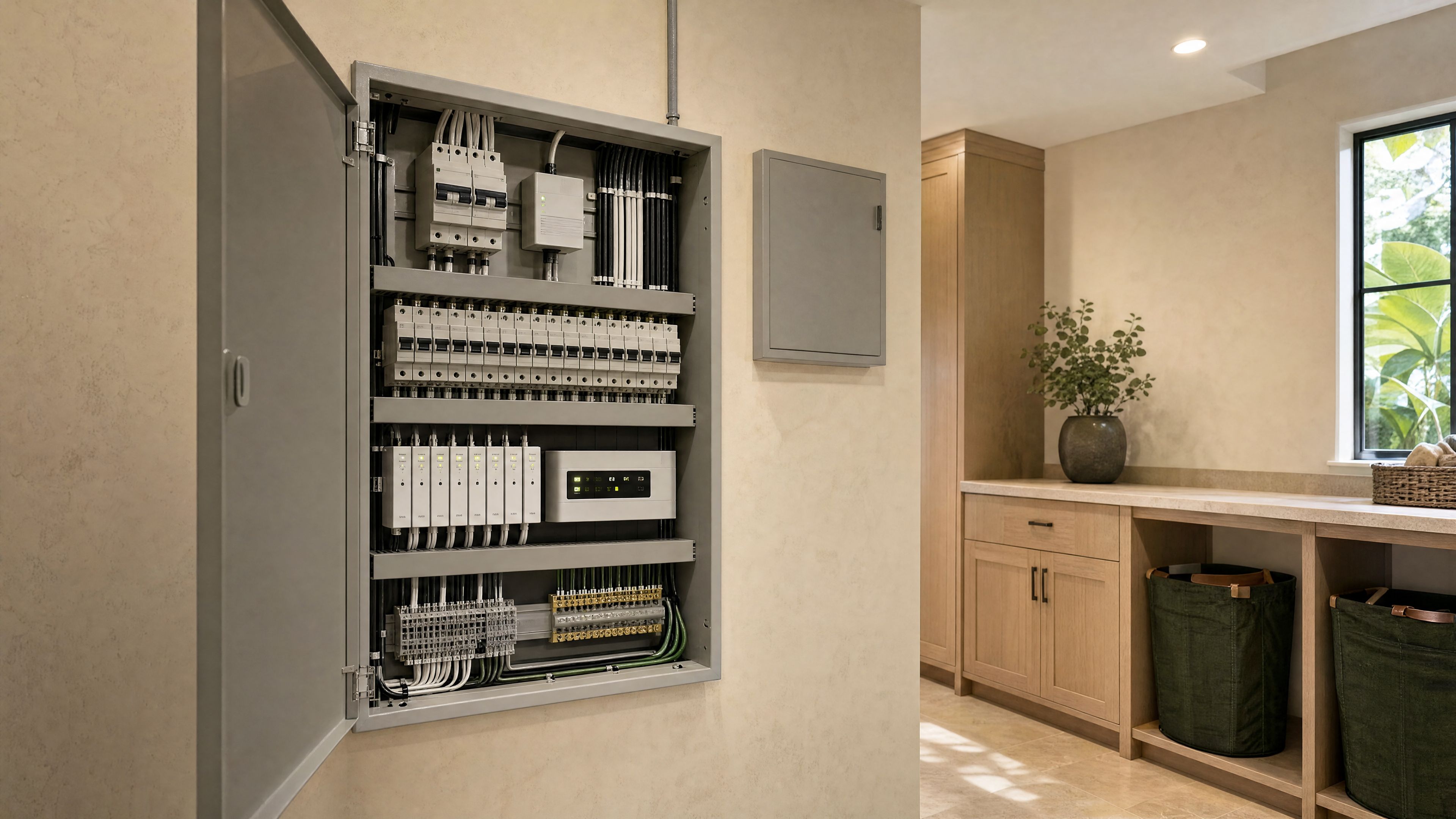
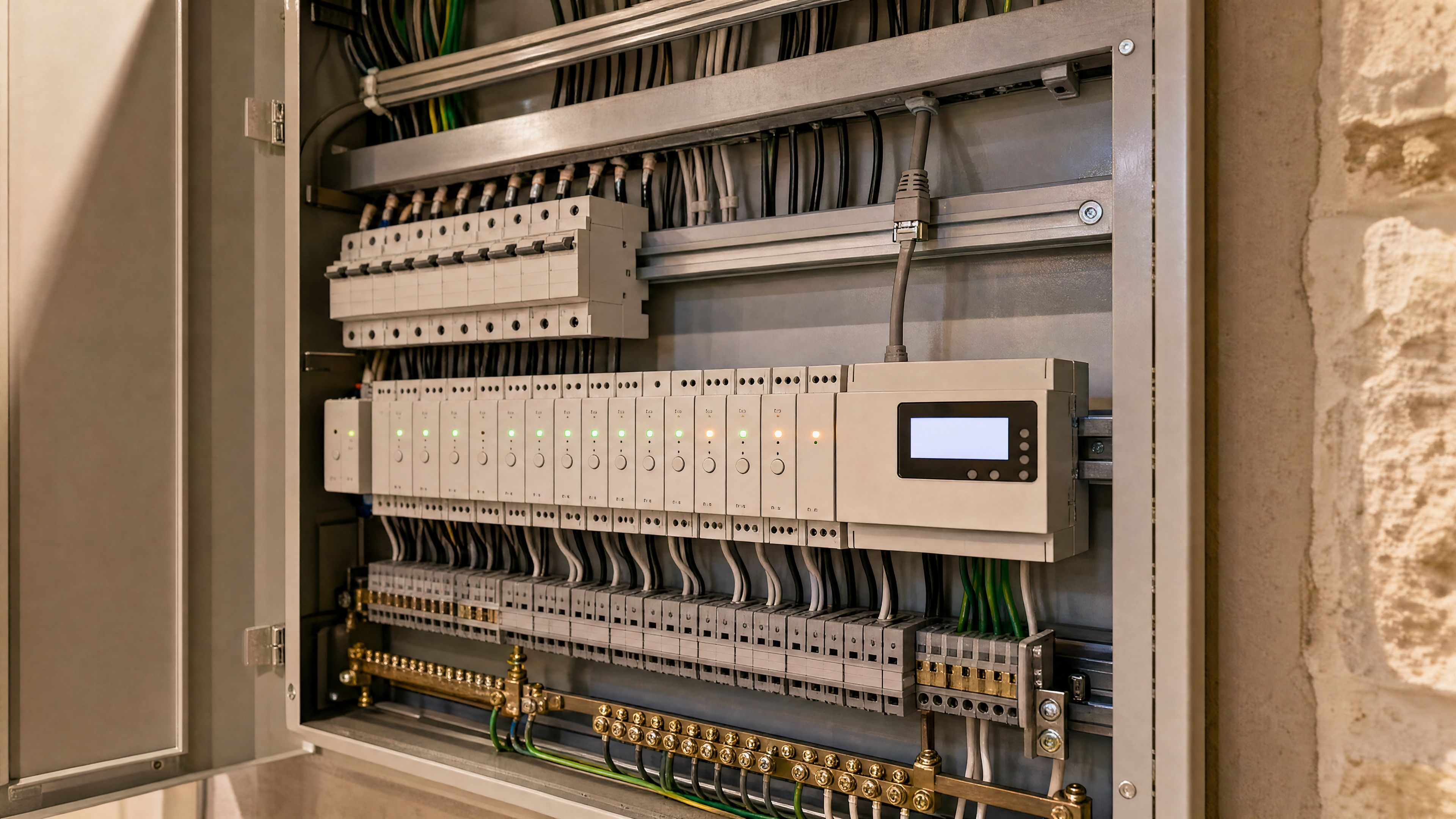
Dimming modules produce heat, and every manufacturer publishes an operating temperature range, clearances and ventilation requirements for its enclosures. Control4’s 8-channel dimmer data sheet lists an operating range up to 104°F, and Lutron’s enclosure application note requires its modules to be derated when the surrounding room is warmer than 86°F. A Florida garage can exceed those conditions for much of the year, even though it is a common suggestion elsewhere. A conditioned utility room or dedicated equipment space is usually the better choice.
The location also needs working space in front of the enclosure, a feed from the main electrical panel, a route for every lighting home run and a network connection for the controller. Electrical code keeps overcurrent devices such as breakers out of clothes closets, so a wardrobe is not an option. Keep the panel close to the main electrical panel and the network equipment where possible, and away from pool equipment rooms where humidity and chemicals collect. In a coastal flood zone, electrical equipment must sit at or above the required flood elevation, and some counties add extra height.
Protect the electronics from surges
Lightning and utility switching can send voltage spikes through the wiring, and the electronics in a lighting panel are more sensitive than a standard breaker. Ask whether the home has surge protection at the main service. The 2020 National Electrical Code, which the current Florida Building Code uses, requires a surge protective device for dwelling services. A second protective device at the lighting panel, plus protection for the network equipment, adds another layer.
Surge protection reduces risk rather than removing it. Keep the controller’s programming backed up off site so the system can be restored quickly if hardware ever needs replacing.
Decide what happens when power returns
After an outage, power may flicker on and off before it settles. Ask how the selected system recovers: whether zones return to their previous state, stay off or follow a defined scene. Few people want every light in the house switching on at three in the morning when the grid comes back. Manufacturers document this behavior; Lutron, for example, explains what its systems do after a power outage, including that scheduled events missed during the outage do not run afterward.
Test the behavior during commissioning by switching off the panel feed and restoring it, so you know what to expect.
Plan the generator and battery backup together
If the home has a standby generator or battery system, decide which lighting zones it should carry: perhaps the kitchen, a path to each bedroom, the stairs and a few exterior lights, rather than every cove and garden fixture. Your licensed electrician can arrange the lighting panel’s feed to suit that plan.
The controller, network switch and router deserve a small battery backup of their own, so keypads and scenes stay available while the generator starts and the internet connection returns. Some processors are powered over the network cable, which makes backup for the network switch essential rather than optional.
Expect the internet to drop
Ask each manufacturer how its system behaves without internet access. Systems that run scenes and schedules on a local processor keep keypads, timeclocks and sensors working; remote app access, voice assistants and cloud features return when the connection does. A wired connection between the controller and the router avoids depending on Wi-Fi for the core system.
Seasonal homes and long absences
For owners who spend summers away, lighting control can do quiet but useful work. Away scenes can vary lights in a believable pattern, exterior lights can follow an astronomic timeclock that tracks sunset through the year, and remote access lets you check the house or switch zones from elsewhere.
Treat remote access as part of the home’s security. Use unique passwords and two-factor sign-in where offered, keep the system’s firmware current and consider a separate network for building systems. Agree who will receive alerts and who can visit if something needs attention before a storm.
Condominiums and community rules
Many Florida condominiums have concrete walls and ceilings, which makes new home runs difficult. A hybrid often works best: a compact panel for the zones that can be rewired during the renovation and wireless keypads and dimmers elsewhere on the same platform.
Before planning, confirm the association’s rules for electrical work, permitted hours, contractor access, elevator reservations and where equipment may be installed. Space for an enclosure inside the unit is often the limiting factor, so measure the candidate closet early.
Coastal exterior lighting and sea turtle rules
Landscape, façade, dock and pool lighting are natural zones for a lighting panel, and Florida’s coast adds a specific responsibility. Coastal counties and cities enforce lighting ordinances during sea turtle nesting season, based on the state’s model ordinance, and the dates vary by location. The Florida Fish and Wildlife Conservation Commission explains how lighting affects nesting sea turtles and lists wildlife-friendly practices.
A control system can help a beachfront home comply: exterior zones visible from the beach can follow a seasonal schedule, and suitable fixtures can be grouped so they are easy to manage. Confirm your local ordinance and fixture requirements before the exterior lighting is specified.
Upgrading an older central system
Some Florida homes already have a centralized system from an earlier generation, such as LiteTouch, which is no longer supported. Those houses often have something valuable in place: lighting zones wired back to a central location. Lutron, for example, publishes a retrofit solution for Savant LiteTouch systems. A survey of the existing panel, wiring and keypad locations shows whether a modern panel can reuse that infrastructure.
Listed components and inspections
A lighting control panel is part of the home’s electrical system, so its parts should carry the listings your inspector expects. In the United States, branch circuits are protected by breakers listed to UL 489. Many compact DIN-rail devices sold internationally are supplementary protectors or carry only a CE mark, which is a manufacturer’s declaration rather than a North American listing; the difference is explained here. Lutron goes further and recommends reviewing the enclosure and module combination with the local inspector before installation. Ask for the listing of the enclosure, modules and breakers in writing.
Permits and licensed work
Florida licenses electrical contractors through the Department of Business and Professional Regulation. A certified electrical contractor may work statewide; registered contractors work in the jurisdictions where they are licensed; and specialty licenses, such as limited energy systems, cover low-voltage work like keypad wiring. A residential electrical contractor license is limited to one- to four-family homes of no more than two stories with a single-phase service of up to 400 amperes, which some larger homes exceed. The license categories are set out in the state rule.
Permit requirements for electrical and low-voltage work vary by county and municipality. Confirm the responsibilities, permits and inspections for your project before work begins.
Scintillax coordinates the lighting design, zones, panel layout and programming with the licensed trades on your project. Share your location, plans or photographs of the existing switches and electrical panel, and tell us how you use the house through the year. We can then discuss a panel location, backup plan and installation sequence that suit it.
Bring your location, room photographs and the details that matter most. We can review the materials, light and practical requirements together.
Plan your lighting controlMaterial studies
The details that make the room.