Lighting control / Scintillax journal
A smart lighting control panel, explained.
How a smart lighting control panel works: relay and dimming modules in one enclosure, keypads and app control, scenes and schedules, and when it suits a Florida home.
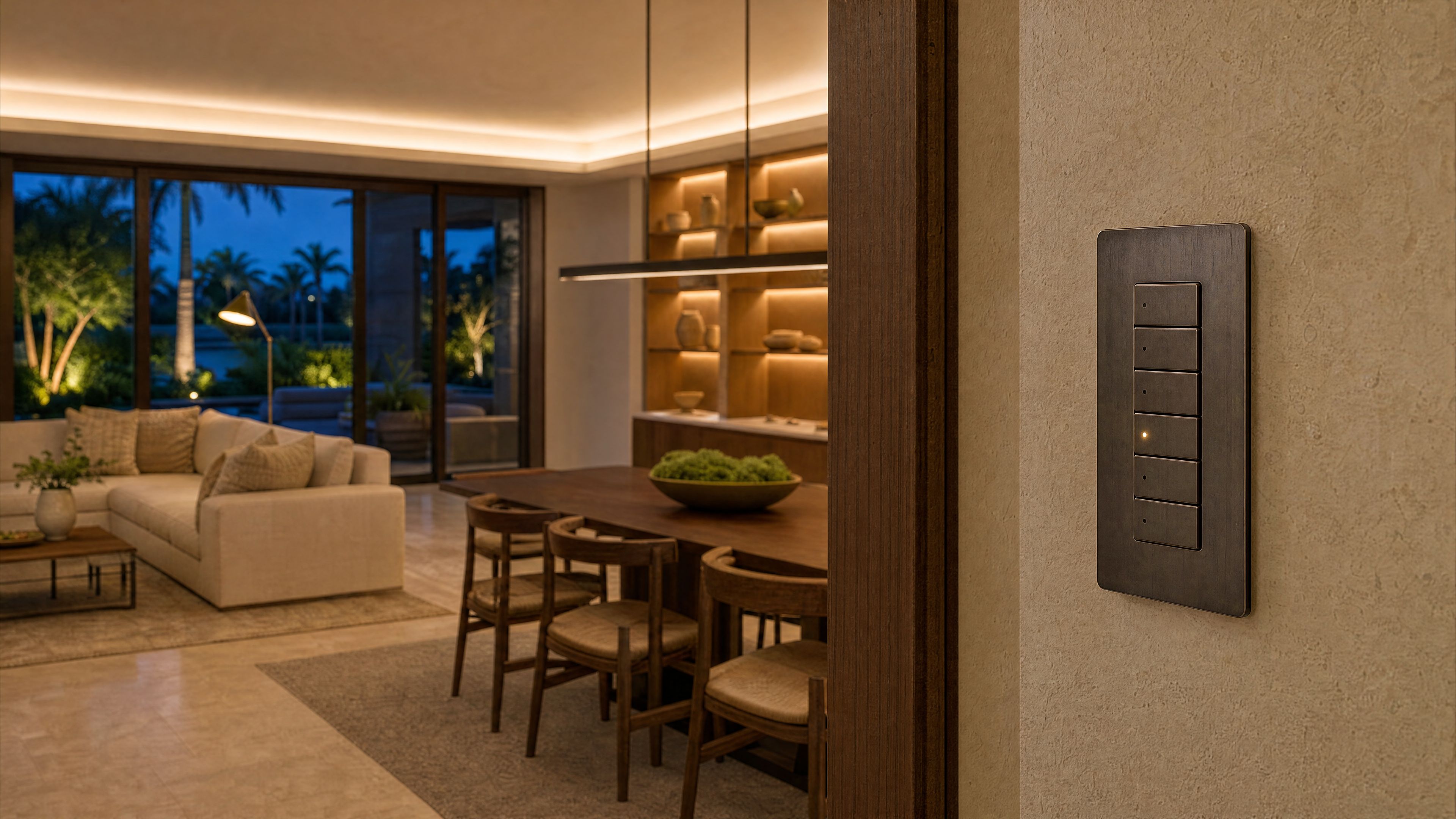
Walk into many homes after dark and you meet the same wall: four, six or eight dimmers side by side, each labeled only by memory. One controls the island pendants, another the cove, a third something nobody remembers. A smart lighting control panel replaces that guesswork with a plan. Every lighting zone is wired back to one enclosure, and the wall keeps a single keypad with buttons named for what you actually do: Cook, Dinner, Pathway, All Off.
This guide explains what sits inside the panel, how it differs from smart switches and smart electrical panels, and which decisions are worth making before the walls are closed. Scintillax designs and installs smart lighting control panels together with the LED lighting they control, across Southwest and Southeast Florida.
What a smart lighting control panel is
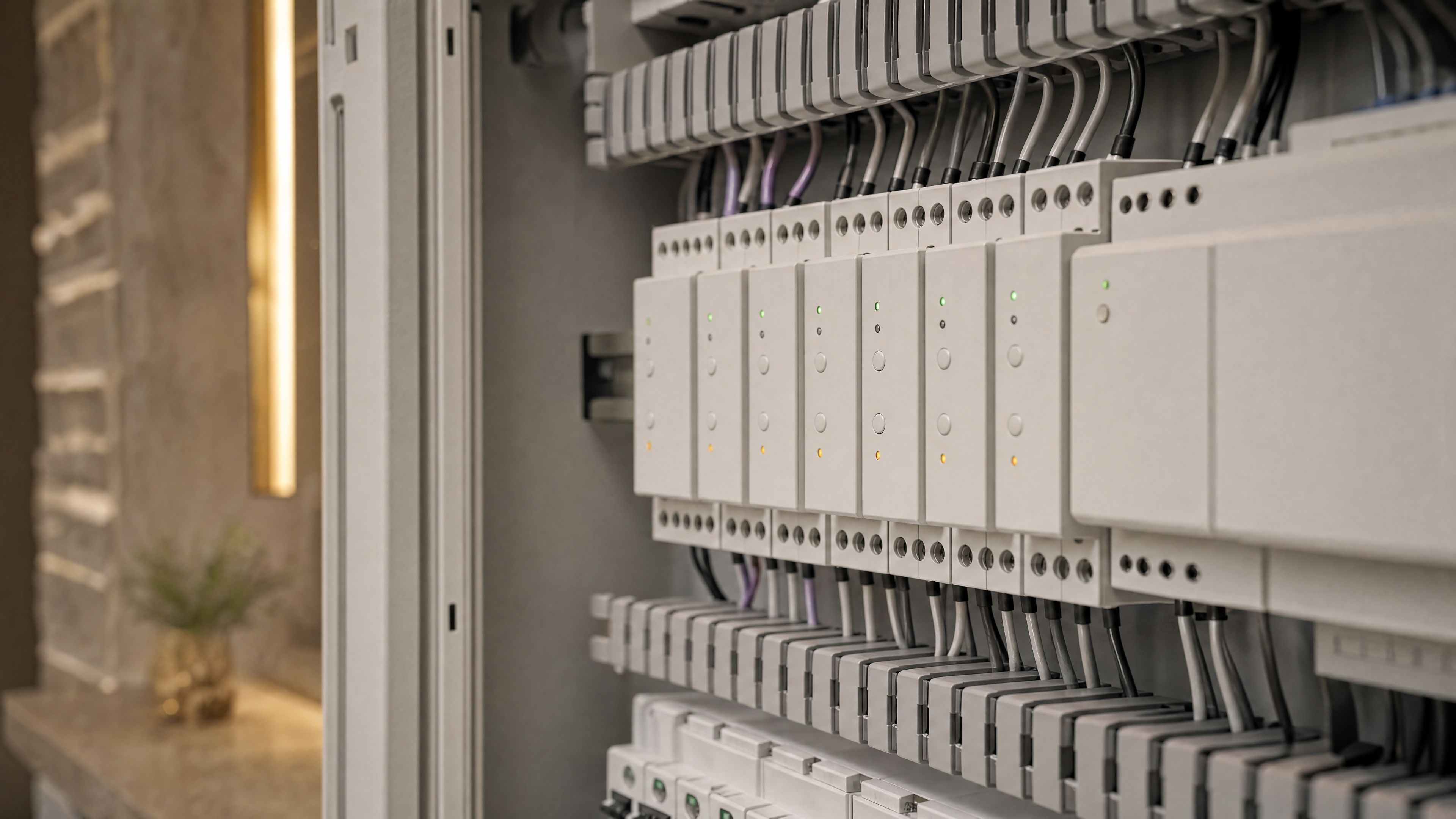
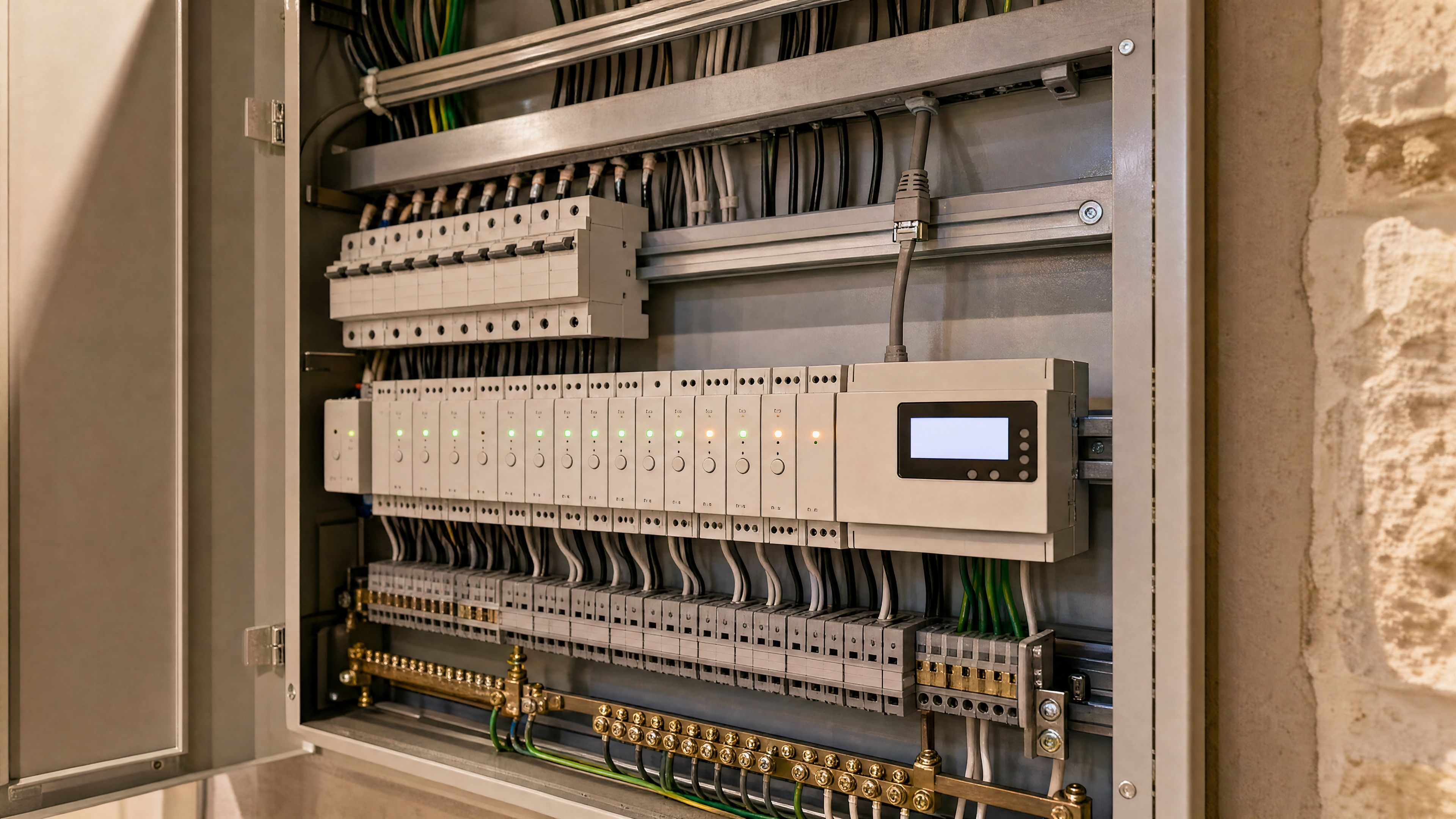
A smart lighting control panel is a metal enclosure, usually mounted near the main electrical panel, that holds the hardware for switching and dimming the home’s lighting. Inside are DIN rails, the standard mounting strips used in electrical equipment, carrying three kinds of component:
- Circuit protection. Breakers for each lighting circuit, often with surge protection for the electronics.
- Relay and dimming modules. A relay switches a zone on and off. A dimming module sets its level. Each module serves one or more zones.
- A controller. Sometimes called a processor or gateway, it stores the scenes and schedules, listens to keypads and sensors, and connects to the home network so you can use an app, a touch screen or a voice assistant.
The same idea goes by several names: centralized lighting control, panelized lighting, a central lighting control system or whole-home lighting control. In each case, the switching and dimming happen in one place rather than inside every wall box. The illustrated panel layout shows where each part sits.
How it differs from smart switches and smart electrical panels
Smart switches and dimmers put the intelligence in the wall. Each device replaces a conventional switch, uses the existing wiring and talks to an app, usually over a wireless network. They are an excellent way to upgrade a finished home room by room. A central panel moves those electronics into one enclosure, which suits new construction and full renovations, when each zone can be wired back to the panel. The comparison of centralized lighting control and smart switches looks at the tradeoffs in detail.
A smart electrical panel is a different product again. Smart panels and smart breakers mainly measure and manage power across the house, often alongside solar, batteries or backup power. They can turn circuits on and off, but they are not designed to dim lighting or recall scenes. A home can have both, because they solve different problems.
What happens when you press a keypad button
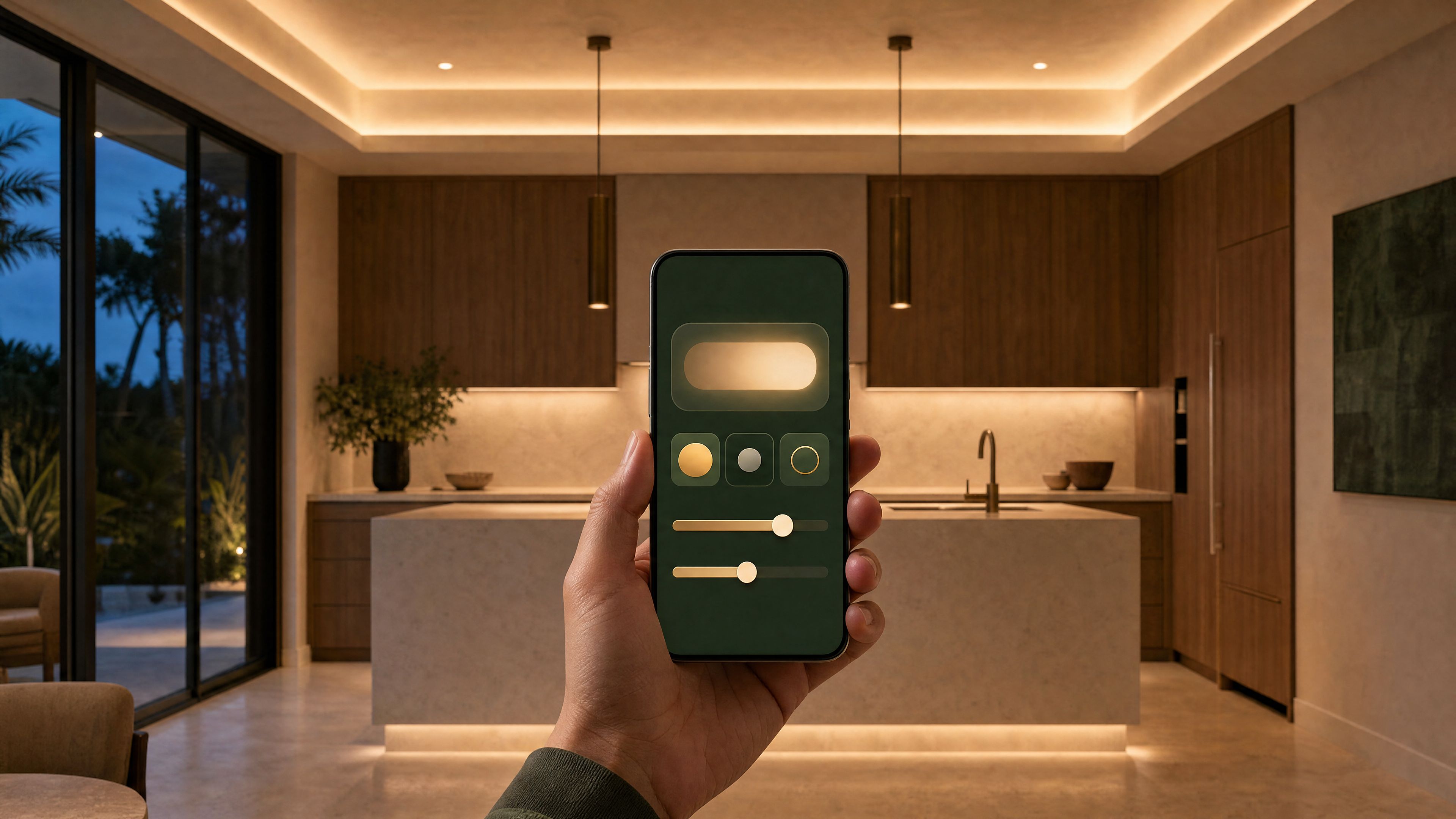
Take an Evening button by the kitchen door. When you press it, the keypad sends a small signal, over a low-voltage cable or a wireless link, to the controller. The controller looks up the scene: perhaps the cove at 40 percent, the pendants at 30, the under-cabinet lights at 20, the toe-kicks at 10 and the dining room at 35. It then tells each module in the panel to move its zone to that level over a few seconds. The keypad’s indicator confirms the scene, and the app shows the same state.
Because the keypad carries a signal rather than the lighting load, one button can affect any zone in the house. The same scene can be repeated at the garage entry, in the app and on a schedule.
Zones, scenes and schedules
A zone is a group of fixtures that always behave together, such as the island pendants. A scene is a set of levels for several zones, recalled together. A schedule runs scenes on its own: landscape and façade lights at sunset through an astronomic timeclock, which follows the changing sunset through the year, then a quieter level at midnight.
Good planning starts with routines rather than hardware. List the moments that matter: early coffee, cooking, a dinner party, a film, the walk to the bedroom at night, leaving for a month. Then decide which zones each moment needs. A home with forty zones may still need only a dozen named scenes, and the keypad engraving should make sense to a guest.
Matching modules to LED fixtures
LED fixtures are controlled through their drivers, and drivers dim in different ways. Some dim on the power line itself with forward-phase or reverse-phase control. Others take a separate low-voltage control signal, such as 0–10V or DALI, a digital standard that gives each driver its own address. Color-changing LED tape often uses DMX. The module in the panel must suit the driver, including its minimum load and the lowest level it can hold without flicker.
That is why the panel is best planned with the lighting rather than after it. The guide to lighting control modules covers relay, phase, 0–10V, DALI and DMX modules and how to read a driver specification.
Where the panel goes in a Florida home
Dimming modules produce heat, and each manufacturer specifies an operating temperature range and clearances. A conditioned utility room, mechanical closet or approved condominium space is usually a better home than a garage that bakes through the summer. The enclosure needs working space in front for service, a feed from the main electrical panel and a network connection for the controller, ideally wired Ethernet.
Storms bring their own questions: surge protection, how the system recovers when power returns and which circuits a generator should carry. The Florida planning guide covers location, outages, condominiums, seasonal homes and permits.
When a central panel makes sense
A central system is most practical when:
- the home is under construction, or the walls and ceilings will be open during a renovation;
- there are many zones, including linear, cabinet, landscape, pool or backlit stone lighting;
- you want calm walls, with one keypad in place of a bank of dimmers;
- scenes need to span several rooms, or the house is empty for long periods.
In a finished home, a hybrid is common: a panel for the areas being renovated and wireless dimmers elsewhere on the same platform.
The cost depends on the number of zones, the mix of dimming and switching modules, the number and finish of keypads, the platform, integration with shades or audio, the wiring conditions and programming time. A zone and scene schedule drawn from your plans or photographs is the basis for a realistic proposal.
If you are weighing brands, the platform comparison covers Lutron, Control4, Crestron, Savant, KNX and Leviton.
Questions to bring to a consultation
- Which lights should come on together, and where do you enter the house most often?
- Which zones are LED, and which drivers do the selected fixtures use?
- Do you want keypads only, or also an app, a touch screen and voice control?
- Where can the panel live, with cool air and room for service?
- What should happen during an internet outage or after a storm?
- Who will look after the programming in five years, and what documentation will you receive?
Bring plans or photographs of the switch banks and electrical panel, and the routines you would like to simplify. We can then discuss the zones, the platform and a realistic installation sequence.
Bring your location, room photographs and the details that matter most. We can review the materials, light and practical requirements together.
Plan your lighting controlMaterial studies
The details that make the room.